
Stepping Beyond the Lab: Two Cross-University Mobility Stories within EUTOPIA_HEALTH
Go to content Navigation Direct access Connection

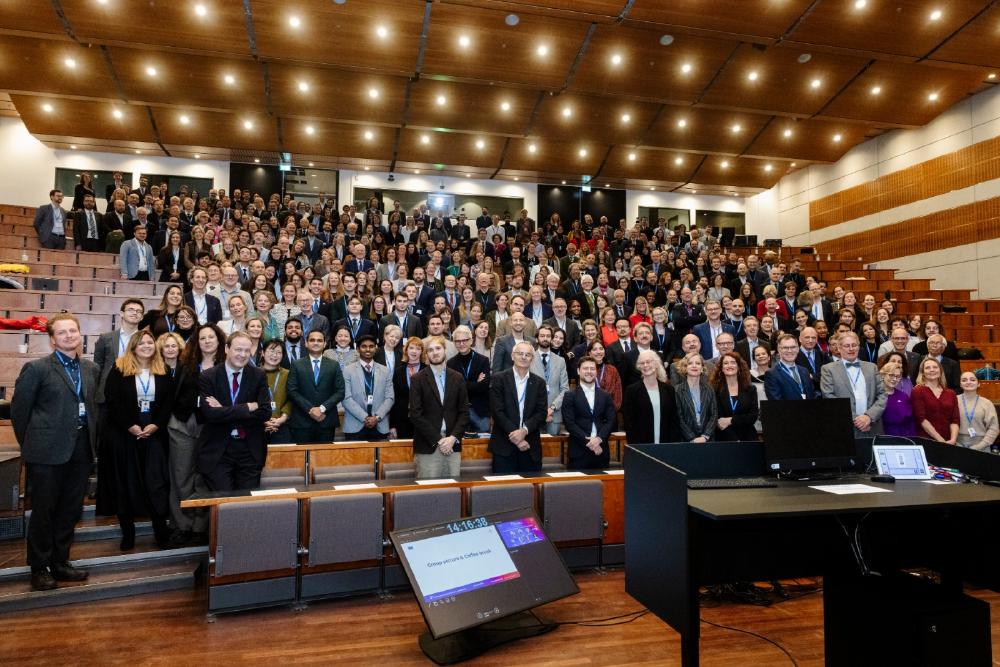
Armando Uribe-Echeverria – Copenhagen, 17-18 December 2025: 2d European Science Diplomacy Conference: Bridging divides in a fragmented world"
Most conferences begin by describing the world as it ought to be. This one began by acknowledging the world as it is — fractured, competitive, and increasingly distrustful of its own knowledge. What followed, over two days in Copenhagen, was less a celebration of science diplomacy than a sober reflection on what happens when it is neglected, misunderstood, or instrumentalised.
Two voices, in particular, cut through the polite vocabulary of international meetings. Enrico Letta and Macharia Kamau did not speak of science diplomacy as a fashionable policy add-on. They spoke of it as a matter of power, responsibility, and peace.
Letta, former Prime Minister of Italy and now an academic and author of a major EU report on research, innovation, and the Single Market, started from an observation so obvious it is often ignored. Science and technology now move faster than politics. They are global, while decision-making remains stubbornly national. This mismatch, he argued, is not merely inefficient; it is dangerous.
Governments continue to respond with tools designed for a slower, more contained world. Regulation arrives late, diplomacy later still. What is missing is anticipation — not prediction, but preparedness. The ability to think through possible futures before they arrive.
Europe, Letta noted, has become adept at regulating once technologies have matured. It struggles, however, to act at the moment of emergence. COVID-19 made the cost of this habit visible. Reacting late proved more expensive — economically, socially, and politically — than any investment that preparedness would have required. From this followed his defence of what he calls the Fifth Freedom. The European Single Market rests on four freedoms: the free movement of goods, services, capital, and people. Knowledge, however — skills, research capacity, innovation — remains fragmented across 27 systems. The result is a form of waste that rarely appears in budgets but quietly erodes Europe’s strength: duplicated efforts, stalled careers, and laboratories competing rather than converging.
The absence of a European diploma, Letta argued, is not a symbolic flaw. Symbols shape behaviour. Erasmus transformed a generation because it was tangible. The Fifth Freedom concerns the intangible — and that, paradoxically, is where Europe now loses the most ground. There was no nostalgia in Letta’s argument, only urgency. The world economy in which the Single Market was conceived no longer exists. Europe’s difficulty is not weakness, but dispersion. Twenty-seven voices, however well-intentioned, rarely sound like one. In this reading, science diplomacy is not cultural exchange. It is the mechanism through which Europe can regain coherence without surrendering openness. It requires avoiding strategic naïveté — openness without protection — while resisting the temptation to retreat behind walls. “As open as possible, as closed as necessary” was not presented as a slogan, but as a condition for survival.
If Letta spoke about anticipation and coherence, Macharia Kamau spoke about consequence.
Kamau, a Kenyan diplomat and one of the principal architects of the United Nations Sustainable Development Goals, placed science diplomacy within a broader polycrisis: geopolitical fractures, persistent inequality, climate breakdown, and accelerating technological change unfolding at the same time. Sixty per cent of the SDGs, he reminded the audience, are off track. This, he argued, is not a failure of ambition but of global architecture. For centuries, diplomacy has been understood as power by other means. That logic never disappeared. In recent years, it has returned openly — replacing institutions with personalities, expertise with instinct, and long-term strategy with transaction. Scientists were dismissed by the tens of thousands in the early Trump years. Knowledge itself became an inconvenience.
Science diplomacy, Kamau argued, matters precisely because it rejects that logic. It must not become an extension of competition or war. If it does, it loses its meaning.
His warning sharpened when he turned to technology. Artificial intelligence, quantum computing, and synthetic biology are no longer neutral tools. They are proxies for geopolitical influence. Access to frontier technologies is uneven, data is monetised and privatised, and decisions taken in a handful of corporate centres quietly shape lives far beyond their borders.
In this context, he stated, a European framework for science diplomacy is not bureaucratic ambition. It is geopolitical necessity. Europe, with more than a million researchers and the world’s most extensive public research programmes, has both legitimacy and responsibility — but only if it looks beyond itself.
Africa, Kamau insisted, is central to that choice. With a median age of 19 and immense human and natural potential, it represents either Europe’s greatest opportunity or its future vulnerability. Less than one per cent of global R&D currently takes place there. That imbalance will not last. Europe can choose equitable co-development now, or strategic marginalisation later. This is not charity, said he. Aid mentalities misunderstand power. Extractive models build resentment; joint scientific infrastructure builds trust. Science diplomacy, taken seriously, can create global public goods and reduce the likelihood of conflict.
Kamau’s warning, however, was precise. None of this will happen if Europe limits its idea of peace to one conflict alone. A continent that mobilises fully for Ukraine, while failing to devote comparable attention to ending wars in Sudan or the Democratic Republic of Congo, cannot credibly claim to be building a global science diplomacy. Peace cannot be selective without becoming incoherent. Cooperation cannot flourish where conflict is managed by omission.
Between Letta and Kamau ran a single line connecting anticipation to peace. One warned of the cost of reacting too late; the other of the cost of forgetting where responsibility lies. Science diplomacy, in their combined argument, is neither idealism nor technique. It is a political choice — about what Europe decides to see, and what it allows itself not to see.
Outside the conference halls, Copenhagen had already slipped fully into winter. A ceiling of clouds pressed down on the city, rain drifted in without urgency, and the day started late and ended early. Yet the streets remained lit. Windows glowed, bicycles moved steadily through the dusk, and people filled the short hours walking and meeting in cafés as if refusing to surrender them. It was an ordinary scene, and therefore instructive. In a season of limited light, continuity depends on what is deliberately kept on.
In Copenhagen, science diplomacy was presented in those terms — not as illumination, but as maintenance. Quiet, demanding, and urgent.