

Summer & Winter Schools of EUTOPIA Partners - 2026
This page lists all Summer and Winter Schools from EUTOPIA open to our wide community of European students.
Summer Schools
- Babes-Bolyai University
Coming soon- Vrije Universiteit Brussel
Joint project of HALL (Brussels) and EKFZ (Dresden) Summer School 2026: Digital Health at the Crossroads: Balancing Progress and Individual Rights
The digital transformation of healthcare is unlocking unprecedented opportunities for economic growth and scientific advancement, but it also raises urgent questions about how to safeguard individual rights and public interest. How can we harness the power of digital health innovation while ensuring ethical governance, legal compliance, and equitable access? The HALL-EKFZ Summer School 2026 is designed to explore these tensions and identify pathways to resolve them.
Building on the success of the 2024 Brussels and the 2025 Dresden editions, we are thrilled to bring the Summer School back to Brussels for its third iteration. This year’s program, “Digital Health at the Crossroads: Balancing Progress and Individual Rights”, will gather leading scholars, policymakers, industry experts, and practitioners of the field. Together, we will dissect the complexities of digital health and collaborate on solutions that balance progress with protection.
Programme Outline
The Summer School features six intensive modules, each comprising at least two sessions dedicated to a core theme:
1. Health Data for Research and Innovation: Balancing Progress and Privacy
2. Cybersecurity in Healthcare: Safeguarding Innovation
3. AI and Intellectual Property in Healthcare: Navigating Governance and Liability
4. Mental Health and Well-Being: Ethical Design and Regulation
5. Medical Technology Design and Development: From Innovation to Market
6. Resilience in Public Health: Preparing for Future Crises
This structure ensures a deep dive into the most critical issues at the intersection of innovation and rights, providing participants with actionable insights and a comprehensive understanding of the field.
Why should you attend?
The Summer School is committed to fostering a diverse and interdisciplinary dialogue. Lectures will be conducted in English, and participants who successfully complete the program and pass the assessment will receive a Certificate of Participation, which can be awarded with 4 ECTS credits. Join us in Brussels to engage with global experts, share perspectives, and contribute to resolving the conflicts at the heart of digital health innovation!
Learn more here.
VUB & NOVA Summer School on EU Policy Making: discount for EUTOPIA students
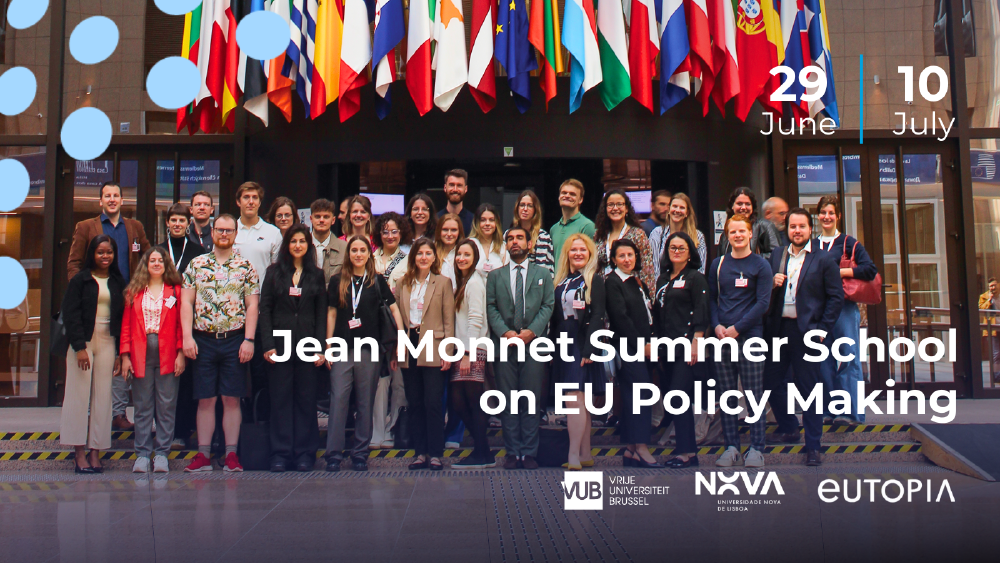
The VUB’s Brussels School of Governance and NOVA University of Lisbon join forces from 29 June to 10 July 2026 for the next edition of the Jean Monnet Summer School on EU Policy Making. This intensive two-week on-campus programme takes place one week in Brussels and one in Lisbon.
The 2026 edition focuses on the external dimensions of EU policy making, with discussions on trade, development, technology and sustainability. Through interactive seminars and study visits, students explore how the EU operates as a global actor while deepening their understanding of EU institutions, EU law and the decision-making process.
Jointly organised by two EUTOPIA member universities, the Summer School awards 6 ECTS.
❗️ Students from all EUTOPIA member universities and EUTOPIA global partner universities receive an exclusive 20% discount on the tuition fee. Find out more!- Ca' Foscari University of Venice
-
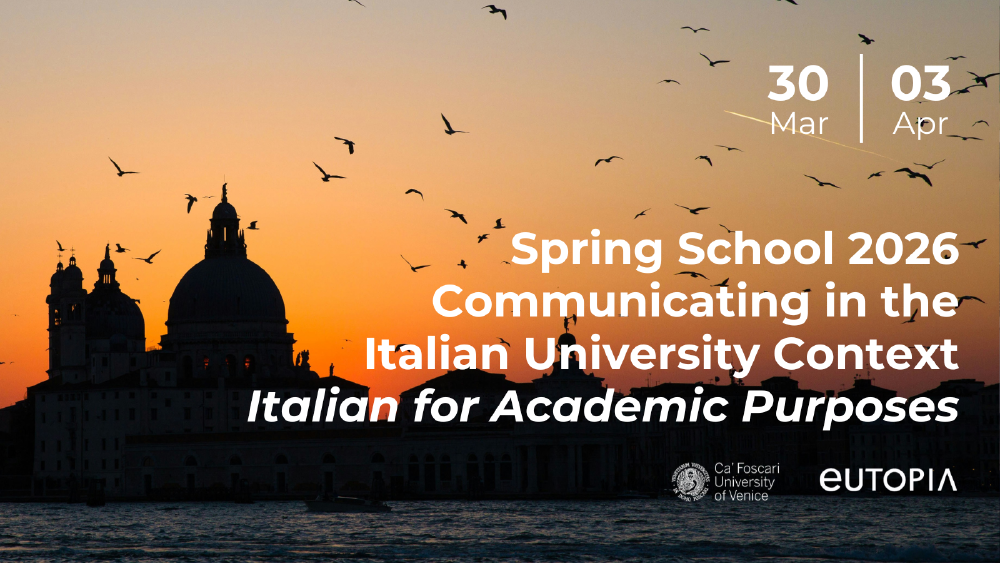
SPRING SCHOOL 2026 Communicating in the Italian University Context Italian for Academic Purposes
Objective
The goal is to offer linguistic and communicative tools useful for tackling real academic situations related to study, research, or teaching.
Who is it for?
The Spring School in Italian for Academic purposes is an intensive one-week training experience designed for:
- international students involved in mobility programs;
-international PhD students and research fellows active in Italy;
- researchers and visiting professors from abroad;
- and in general, anyone wishing to use Italian more effectively in a University environment.
Requirements
Italian language skills of at least level B2 (Common European Framework of Reference) are required. Candidates must own a B2 language certificate (CILS, PLIDA, CELI) or may take a placement test.
What the Spring School offers
The program enables participants to start:
- Mastering formal registers of institutional communication and academic writing skills.
- Developing oral interaction and classroom participation, gaining confidence in communicating with professors, researchers, and colleagues.
- Understanding the Italian academic system, expanding specific vocabulary and improving reading and listening comprehension.
Structure and methodology
The course is based on a practical approach led by Italian L2 experts with extensive university experience
- Thematic workshops focused on academic communication.
- Hands-on activities involving writing and classroom simulations.
- Specific insights to better navigate the dynamics and procedures of the Italian university context.
Interested in applying for the 2026 edition? Find out more - CY Cergy Paris University
-
Summer School 2026 Digital Media: Chatbots for Internet Research?
The LT2D is organising a Digital Media summer school from 15 to 19 June 2026.
For Whom? MA students, PhD students, early career researchers or any researcher willing to improve their digital methodologies skills.
Where? CY Cergy Paris University, a dynamic university in the Parisian area. RER A station Neuville University.
Key- conferences by Prof. Richard Rogers, Chair in New Media & Digital Culture at the University of Amsterdam.
Programme: Introduction: Chatbots for Internet Research? Prompting strategies and ‘research personas’ Annotating and classifying, reflexively Auditing LLMs. How offensive and sensitive are they? Synthetic data. How real is it?A Data Sprint Project
Chatbots have become a ‘part of the pipeline’ in a number of research methodologies in the social sciences and humanities, contributing to formatting, summaries, annotation, labelling and the generation of synthetic data. One question is how to go about using chatbots in the first place for such research tasks and make use of the many best practice guides that have been shared across the research landscape. These guides contain steps about how to prompt and interact with chatbots properly as researchers. But they also advise that the chatbots explain themselves and that researchers validate their outputs. How does one gain confidence in how the chatbots work for the researchers? What to do when the machine and the researcher findings misalign?
When gaining confidence in the chatbot output, one could consider how to ground chatbot findings. These moments raise a series of questions such as when to undertake a manual and/or multiple chatbot comparison. But it would also ask, how does the medium or the platform affect the data and the findings? Here is where guardrail auditing comes into the picture. How to detect the guardrails that have been put up by the chatbots so that they can interact with users without offence? How do they affect the quality of the data and the findings? The goal here is to identify medium and platform issues when using chatbots for research.
Participation fees:
300 euros without housing, 550 euros housing included.
Are you interested in participating?
Contact us at lt2d@cyu.fr
Pre-registration before 15 March 2026 (2-page letter on your interest in the programme and your current research)
Registration: 15 May 2026- Conclusions: Machine-researcher alignment and misalignment
- Register here
LEARNING OUTCOMES
The Paris Summer School of Social Work is an intensive program focused on French social work intervention, delivered in English.It aims to foster intellectual curiosity and prepare participants to work within a very multicultural and international society.
Through a targeted effort to increase awareness, Paris Summer School participants will be able to:
- Appreciate and respect the cultural differences of individuals and groups
- Develop ethics, knowledge and critical thinking skills
- Understand the history of social work and its contemporary issues
- Evaluate social work practice intervention in France within families, groups and communities
- Contribute to making the world a better place through innovative social impact projects.
PROGRAMME FORMAT
The programme is divided into multiple formats that include but are not limited to lectures, field visits, and professional placements. Lectures are online and in-person, delivered in English by experienced teachers and social workers and may include guest presenters. Field visits are delivered out of class, in English or translated from French into English. Professional field placements are carried out in a choice of fields and topics (depending on participant’s level and placement options) in French, with an English speaker on hand. Individual or group study provides time to work on social impact projects Weekly debrief sessions go over field and placement experience and any issue that may need to be addressed.Some reading and research will be expected before and during the programme.
SCHEDULEThe programme is an intensive immersion in French Social Work and way of life.
A typical day will start around 9 am and can end anytime between 5 pm or later, depending on social activities or placements, with the exception of one free afternoon a week.
There is one lecture and visit per day. Morning lectures: between 9:00 am and 12:00 pm. They are carried out in English. Afternoons are dedicated to meeting active professionals in their own environment. Placements: There are 2 days of professional placements during the program. 1/2 day of community outreach Personal work: in addition, each student should expect to undertake at least 1 hour of independent study per day.Evenings are (usually) free for you to enjoy the great Parisian life.
Learn more and apply here by February 7 2026
- Dresden University of Technology
-
Joint project of HALL (Brussels) and EKFZ (Dresden) Summer School 2026: Digital Health at the Crossroads: Balancing Progress and Individual Rights
The digital transformation of healthcare is unlocking unprecedented opportunities for economic growth and scientific advancement, but it also raises urgent questions about how to safeguard individual rights and public interest. How can we harness the power of digital health innovation while ensuring ethical governance, legal compliance, and equitable access? The HALL-EKFZ Summer School 2026 is designed to explore these tensions and identify pathways to resolve them.
Building on the success of the 2024 Brussels and the 2025 Dresden editions, we are thrilled to bring the Summer School back to Brussels for its third iteration. This year’s program, “Digital Health at the Crossroads: Balancing Progress and Individual Rights”, will gather leading scholars, policymakers, industry experts, and practitioners of the field. Together, we will dissect the complexities of digital health and collaborate on solutions that balance progress with protection.
Programme Outline
The Summer School features six intensive modules, each comprising at least two sessions dedicated to a core theme:
1. Health Data for Research and Innovation: Balancing Progress and Privacy
2. Cybersecurity in Healthcare: Safeguarding Innovation
3. AI and Intellectual Property in Healthcare: Navigating Governance and Liability
4. Mental Health and Well-Being: Ethical Design and Regulation
5. Medical Technology Design and Development: From Innovation to Market
6. Resilience in Public Health: Preparing for Future Crises
This structure ensures a deep dive into the most critical issues at the intersection of innovation and rights, providing participants with actionable insights and a comprehensive understanding of the field.
Why should you attend?
The Summer School is committed to fostering a diverse and interdisciplinary dialogue. Lectures will be conducted in English, and participants who successfully complete the program and pass the assessment will receive a Certificate of Participation, which can be awarded with 4 ECTS credits. Join us in Brussels to engage with global experts, share perspectives, and contribute to resolving the conflicts at the heart of digital health innovation!
Learn more here.


- University of Gothenburg
- University of Ljubljana
-
Programme information
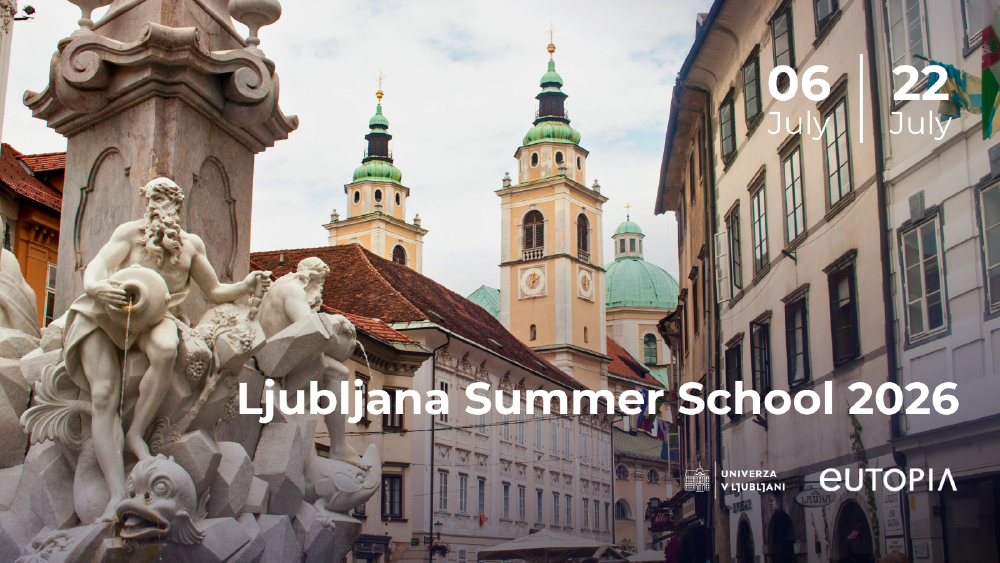
The Ljubljana Summer School is open to bachelor's and master's students, graduates, and young professionals seeking to gain new knowledge in specific fields. We welcome students from partner and non-partner institutions worldwide, including those from the University of Ljubljana. We aim to keep the programme and course groups international and culturally diverse.
Date and location:
6 - 22 July 2026
The programme will take place at the School of Economics and Business of the University of Ljubljana
Application period:
28 January - 4 June 2026
Programme fees:
The programme fees include tuition, study materials, a non-refundable service fee (50 EUR), access to the library and computer rooms on campus, the opening and farewell events, some organised social events, a bus ticket for Ljubljana city buses, and a welcome pack.
Learn more here
HydRoData 2026: Summer School about Hydrology and Data organised by the Unesco Chair on Water-related Disaster Risk Reduction
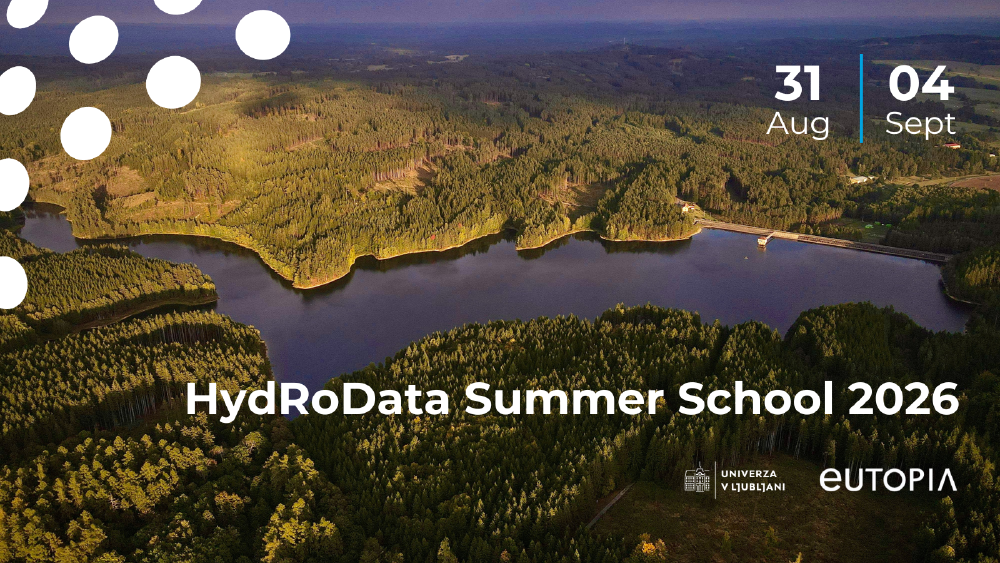
The UNESCO Chair on Water-related Disaster Risk Reduction is organizing a summer school about hydrology and data in hydrology (measurements, data manipulation, analysis, visualization, modelling, etc.). Focus will be on R programming language.
After successful completion of summer school, participants will be awarded with a 2 ECTS certificate.
Date and venue
Summer school will take place from 31st August to 4th September 2026 in Ljubljana, Slovenia. Participants are encouraged to arrive in Ljubljana a day earlier, as the summer school schedule starts on Monday morning (31st August).
Lectures in the scope of the summer school will take place at the Faculty of Civil and Geodetic Engineering, University of Ljubljana, at the Department of Environmental Civil Engineering.
Who can attend?
Summer school is primarily dedicated to PhD students. Post-docs and MSc students are also welcome to apply. The maximum number of participants is 20.
Registration
Registration1,2 is open. To apply, please fill out the following form: HydRoData Summer School 2026 application form.
1If the number of applicants exceeds 20, we will carry out a selection process.
2In the case of less than 10 applications, summer school will not be held. In that case, we will notify you.
Registration deadline: 17th of May 2026.
Learn more here
- NOVA University Lisbon
-
VUB & NOVA Summer School on EU Policy Making: discount for EUTOPIA students
The VUB’s Brussels School of Governance and NOVA University of Lisbon join forces from 29 June to 10 July 2026 for the next edition of the Jean Monnet Summer School on EU Policy Making. This intensive two-week on-campus programme takes place one week in Brussels and one in Lisbon.
The 2026 edition focuses on the external dimensions of EU policy making, with discussions on trade, development, technology and sustainability. Through interactive seminars and study visits, students explore how the EU operates as a global actor while deepening their understanding of EU institutions, EU law and the decision-making process.
Jointly organised by two EUTOPIA member universities, the Summer School awards 6 ECTS.
❗️ Students from all EUTOPIA member universities and EUTOPIA global partner universities receive an exclusive 20% discount on the tuition fee. Find out more!
- Pompeu Fabra University - Barcelona
- The University of Warwick
Winter Schools
- Vrije Universiteit Brussel
-
Winter School on EU Policy MakingFrom Monday 12 to Friday 23 January 2026, the VUB Brussels School of Governance organises the sixth edition of its online Jean Monnet Winter School on EU Policy Making. This highly interactive Winter School (6 ECTS) provides participants a ‘crash course’ in European Union Policy Making. Its focus area is the EU's tech policies, touching on policy discussions related to freedom of expression, data governance, artificial intelligence, disinformation resilience, platform responsibility, and digital development. This Winter School is a challenging and truly interactive online study experience (workshops, simulation game, etc.), with special attention to the social side.
The application deadline is 15 November.A special feature of the Winter School will be the simulation exercise, during which participants team up with students from the EUTOPIA universities to simulate the EU ordinary legislative procedure for two days.
Check out last year’s account of this Winter School!
The Winter School offers a special discount for current students of EUTOPIA universities as well as EUTOPIA global partner universities.
Interested in applying for the 2026 edition? Find out more
- Ca' Foscari University of Venice
-
Winter School on Italian Langauge and CultureVenice offers an ideal setting for a Winter School focused on both the Italian language and its rich cultural heritage. The city’s compact, walkable nature allows students to easily immerse themselves in Venetian life, interacting with the local community and experiencing the authentic atmosphere of this historic city.
The programme, which runs for two weeks from January 26 to February 6, 2026, consists of 30 hours of Italian language classes at the Ca’ Foscari School for International Education, held at Palazzina Briati in Venice. These classes, designed for absolute beginners (level A1), take place in the mornings.
In addition to the language classes, the curriculum includes 5 hours of cultural activities during some afternoons. These activities will offer students the opportunity to explore Venice’s historically and artistically significant sites, participate in walking tours, and enjoy local experiences that bring Italy’s rich traditions and artistic legacy to life.
Applications open on October 6th and close on November 21st.
Please note that accommodation is not provided, but the School will suggest a range of possible housing arrangements for participants.
For more details, please visit Ca' Foscari website. - University of Ljubljana
-
Doctoral Winter School Online Programme
The Doctoral Winter School offers an engaging and internationally oriented online learning experience tailored for doctoral students, post-doctoral researchers, academics, and professionals from diverse fields around the world. Held from 9 to 13 February 2026, the programme provides four hours of live online instruction daily (14:00–18:00 CET), enabling participants to deepen their methodological and research skills from any location.
Each course carries 4 ECTS credits and includes synchronous lectures, access to course materials and software, as well as full administrative support. Upon completion, all participants receive an official Certificate of Attendance, while those who fulfill all course requirements and pass the final assessment may request an official Transcript of Records for ECTS recognition. The selection of courses—ranging from applied time-series analysis and data science to causal inference, scientific writing, and navigating the doctoral research journey—is led by experienced instructors from European universities.
Applications are open until 28 January 2026 (23:59 CET). Prospective participants must complete the online application form, including personal information, a CV, and a motivation letter. After submission, applicants will be notified of their admission status within two weeks. Accepted candidates will receive payment instructions, and admission is confirmed only upon receipt of the 600 EUR course fee, payable in a single installment. Courses are subject to cancellation only in exceptional circumstances, in which case transfers or full refunds will be offered.
For more details, please visit the University of Ljubljana website.