

Biomineralization in Medicine, Archaeology, and Cultural Heritage
"Biomineralization in Medicine, Archaeology, and Cultural Heritage" stands at the forefront of transforming the educational and research landscape through a dynamic fusion of innovation, sustainability, and interdisciplinary collaboration at the intersection of biology, materials science and medicine. Our mission is to create a vibrant global network where knowledge sharing and multicultural exchange drive forward-thinking solutions looking at applications of electron microscopy and vibrational spectroscopy for the analysis of mineralised tissues in a range of contexts. As we engage in ground-breaking projects, we aim to cultivate an inclusive environment that embraces digital transformation and fosters social impact. Our educational activities focus on experiential learning and skill development, ensuring students and experts alike benefit from varied pedagogical approaches. Research initiatives are meticulously designed to address contemporary challenges, promoting policy development and public engagement at all levels. We are committed to building capacity and enriching the community through educational workshops, collaborative projects, and curriculum innovations. Join us as we shape the future of global education and research.
- Lead GU: Furqan Ali Shah
-
Contact E-mail: furqan.ali.shah@biomaterials.gu.se
Associate Professor in Biomaterials
https://www.gu.se/en/about/find-staff/furqanalishah
At the intersection of biology, materials science, and medicine, my research focusses on the structure–property–function relationships in mineralized biological tissues (bone and teeth), through multiscale and multimodal characterization of micro-to-nanoscale structure, chemical composition, and nanomechanical behaviour. This is made possible by correlative use of nano-analytical electron microscopy (with complementary crystallographic and spectroscopic techniques), vibrational spectroscopy (i.e., micro-Raman spectroscopy and Fourier-transform infrared spectroscopy), X-ray micro-computed tomography (micro-CT), histology & immunohistochemistry.
The major focus areas include:(i) bone and teeth in health and disease, (ii) development of novel strategies for mineralized tissue regeneration, and (iii) bone response to various classes of biomaterials, such as 3D printed titanium (and titanium alloys); biodegradable metals such as magnesium (and magnesium alloys); and a range of calcium phosphate materials.
Key publications:Shah FA. Revisiting the physical and chemical nature of the mineral component of bone. Acta Biomater. 2025 (in press)
Micheletti C, Shah FA. Bone hierarchical organization through the lens of materials science: Present opportunities and future challenges. Bone Rep. 2024;22:101783
Shah FA, Jolic M, Micheletti C, Omar O, Norlindh B, Emanuelsson L, Engqvist H, Engstrand T, Palmquist A, Thomsen P. Bone without borders – Monetite-based calcium phosphate guides bone formation beyond the skeletal envelope. Bioact Mater. 2023;19:103
Shah FA. High-resolution Raman spectroscopy reveals compositional differences between pigmented incisor enamel and unpigmented molar enamel in Rattus norvegicus. Sci Rep. 2023;13:12301
Shah FA. Magnesium whitlockite – omnipresent in pathological mineralisation of soft tissues but not a significant inorganic constituent of bone. Acta Biomater. 2021;125:72
Shah FA. Towards refining Raman spectroscopy-based assessment of bone composition. Sci Rep. 2020;10:16662
Shah FA, Ruscsák K, Palmquist A. 50 years of scanning electron microscopy of bone – A comprehensive overview of the important discoveries made and insights gained into bone material properties in health, disease, and taphonomy. Bone Res. 2019;7:15
Shah FA, Thomsen P, Palmquist A. Osseointegration and current interpretations of the bone-implant interface. Acta Biomater. 2019;84:1
Shah FA, Thomsen P, Palmquist A. A review of the impact of implant biomaterials on osteocytes. J Dent Res. 2018;97:977
Shah FA, Lee BEJ, Tedesco J, Larsson Wexell C, Persson C, Thomsen P, Grandfield K, Palmquist A. Micrometer-sized magnesium whitlockite crystals in micropetrosis of bisphosphonate-exposed human alveolar bone. Nano Lett. 2017;17:6210 - Partner UW: Charlotte Primeau
-
Contact E-mail: charlie.primeau@warwick.ac.uk
Dr. Charlie (Charlotte) Primeau is an Assistant Professor in Forensic Imaging and leads the forensic micro-CT department at the Warwick Manufacturing Group (WMG), University of Warwick. Her current practice is exclusively focused on forensic post-mortem micro-CT imaging. Dr. Primeau’s expertise supports homicide and serious crime investigations across UK police forces, in cases involving child and vulnerable adult abuse, sharp and blunt force trauma, strangulation, and dismemberment. She has a dual background as a diagnostic radiographer and as a certified forensic anthropologist (FA Level III) with the Royal Anthropological Institute (RAI) of the UK. Her research interest is particularly centred on forensic imaging in the context of child and elder abuse.
https://warwick.ac.uk/fac/sci/wmg/about/location-facilities/forensic/people/charlotteprimeau/ - Partner UL: Tamara Leskovar
-
Contact E-mail: tamara.leskovar@ff.uni-lj.si
Assistant Professor of Archaeological Methodology, Department of Archaeology, Faculty of Arts, University of Ljubljana
https://www.ff.uni-lj.si/en/staff/tamara-leskovar - Partner VUB: Barbara Veselka
-
Contact E-mail: barbara.veselka@vub.be
Dr. Barbara Veselka is an Assistant Professor of Archaeological Science and Head of the Osteoarchaeology Laboratory at the Vrije Universiteit Brussel, where she studies burnt and unburnt human remains at the macroscopic, radiological, and microscopic levels. She holds a Master’s in Archaeology of MesoAmerica and a Master of Science in Human Osteology and Funerary Archaeology from Leiden University, the Netherlands, where she also earned her PhD in Human Osteoarchaeology. Her doctoral thesis (D-lightful Sunshine Disrupted) focused on vitamin D deficiency as a method for reconstructing changes in sociocultural practices resulting from industrialisation in 17th–19th-century Netherlands. The study of vitamin D deficiency remains an important focus of her research on both cremated and inhumated human remains from collections worldwide.
https://www.barbaraveselka.nl/
https://researchportal.vub.be/en/persons/barbara-veselka/activities/ - Partner VUB: Christophe Snoeck
-
Contact E-mail: christophe.snoeck@vub.be
Assistant Research Professor, AMGC, VUB
https://www.bb-lab.be/head/biography/
https://researchportal.vub.be/en/persons/christophe-snoeck
- November 2025: Biomineralization in Medicine, Archaeology, and Cultural Heritage seminar
-
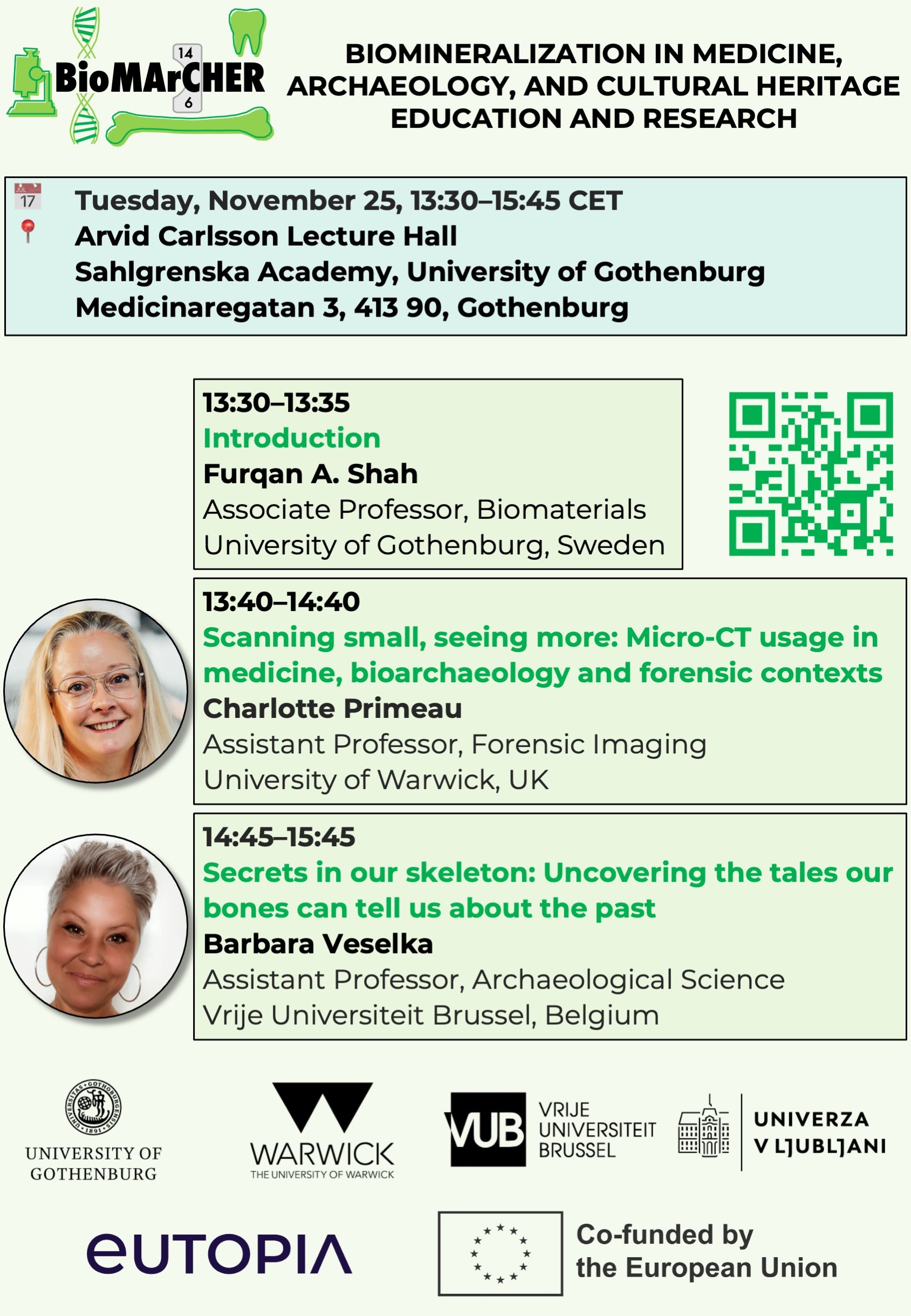
As part of the EUTOPIA Connected Community BioMArCHER, you are invited to a seminar on Biomineralization in Medicine, Archaeology, and Cultural Heritage at the University of Gothenburg. The event brings together researchers working at the intersection of medicine, archaeology, and cultural heritage to explore how imaging and spectroscopic techniques are advancing our understanding of mineralised tissues.
�� When:
Tuesday, 25 November, 13:30–15:45 CET
�� Where:
Arvid Carlsson Lecture Hall
Sahlgrenska Academy, University of Gothenburg
Medicinaregatan 3, 413 90 Gothenburg, Sweden
Programme:
13:30–13:35, Introduction
Furqan A. Shah, Associate Professor, Biomaterials
University of Gothenburg, Sweden
13:40–14:40, Scanning small, seeing more: Micro-CT usage in medicine, bioarchaeology and forensic contexts
Charlotte Primeau, Assistant Professor, Forensic Imaging
University of Warwick, UK
14:45–15:45, Secrets in our skeleton: Uncovering the tales our bones can tell us about the past
Barbara Veselka, Assistant Professor, Archaeological Science
Vrije Universiteit Brussel, Belgium
About the talks:
Scanning small, seeing more: Micro-CT usage in medicine, bioarchaeology and forensic contexts: Micro-computed tomography (micro-CT) is an imaging modality originally developed for industrial inspection purposes but is increasingly being adopted in medical, biomedical, odontology, archaeological, and forensic research. At Warwick Manufacturing Group (WMG), University of Warwick, the facility houses five industrial micro-CT scanners capable of imaging a wide range of sample types—from small biological specimens to large anatomical or archaeological structures. Micro-CT offers exceptionally high spatial resolution and non-destructive three-dimensional visualisation, enabling detailed internal examination of bone, tissue, and artefacts without physical sectioning. In addition, there is a large 3D printing and surface scanning capability also used for industry, research and cultural heritage. This presentation will outline the key differences between micro-CT and conventional medical CT scanning and will illustrate how micro-CT has been applied at WMG and collaborating institutions to advance diverse areas of research—from investigating biomaterial properties and skeletal elements to reconstructing past lives and supporting forensic investigations of criminal cases. 3D scanning and printing will also be discussed, and how this is used to support cultural heritage, biomechanics and forensic court presentations. Examples from other research groups will also be incorporated to illustrate the full breadth of the diverse capabilities of micro-CT imaging and 3D scanning and printing.
Secrets in our skeleton: Uncovering the tales our bones can tell us about the past: Human remains, burnt and unburnt, are the only direct evidence of individuals that lived in the past, but after being years and years in the ground, a lot of it may be lost. What can we still find out? Basic analysis of the human remains includes the assessment of biological sex and age-at-death, stature, and pathological anomalies. This helps us to reconstruct the distribution of age and sex throughout a cemetery and observe age- and sex-related patterns in diseases. Most methods we used are macroscopic assessments, as these are cheap and often easy to use. However, there are some limitations and often we also employ chemical and microscopic evaluation methods to go deeper. Isotope analyses allow us to identify mobility patterns, land use, and can help us to reconstruct the diet. The application of (micro)computed tomography for the evaluation of pathological anomalies is a non-destructive way of finding out what is going on inside, and in some cases aDNA can help us understand kinship and family ties. With this information we try to reconstruct the sociocultural organization of past populations.
About the speakers:
Dr. Charlie (Charlotte) Primeau is an Assistant Professor in Forensic Imaging and leads the forensic micro-CT department at the Warwick Manufacturing Group (WMG), University of Warwick. Her current practice is exclusively focused on forensic post-mortem micro-CT imaging. Dr. Primeau’s expertise supports homicide and serious crime investigations across UK police forces, in cases involving child and vulnerable adult abuse, sharp and blunt force trauma, strangulation, and dismemberment. She has a dual background as a diagnostic radiographer and as a certified forensic anthropologist (FA Level III) with the Royal Anthropological Institute (RAI) of the UK. Her research interest is particularly centred on forensic imaging in the context of child and elder abuse.
Dr. Barbara Veselka is an Assistant Professor of Archaeological Science and Head of the Osteoarchaeology Laboratory at the Vrije Universiteit Brussel, where she studies burnt and unburnt human remains at the macroscopic, radiological, and microscopic levels. She holds a Master’s in Archaeology of MesoAmerica and a Master of Science in Human Osteology and Funerary Archaeology from Leiden University, the Netherlands, where she also earned her PhD in Human Osteoarchaeology. Her doctoral thesis (D-lightful Sunshine Disrupted) focused on vitamin D deficiency as a method for reconstructing changes in sociocultural practices resulting from industrialisation in 17th–19th-century Netherlands. The study of vitamin D deficiency remains an important focus of her research on both cremated and inhumated human remains from collections worldwide.
We look forward to welcoming you to this interdisciplinary exchange.
For further information regarding the event, please contact:
Furqan A. Shah (furqan.ali.shah@biomaterials.gu.se)
PhD, Associate Professor, Biomaterials
University of Gothenburg, Sweden
Coordinator BioMArCHER, EUTOPIA Connected Communityhttps://www.gu.se/en/research/biomineralization-and-biointerfaces
ORCID Google Scholar LinkedIn Bluesky
Seminar