As patterns of work evolve across borders, so too must the legal frameworks that govern them. From digital nomads to cross-border work, the increasing mobility of workers is raising complex questions that sit at the intersection of labour law, tax law, and social security systems.
It is these challenges that the EUTOPIA Connected Community (CC) “Law, The Final Frontier: Legal Challenges and Solutions for Mobile Individuals and a Changing World of Work” seeks to address. Bringing together academics and students from across the alliance, the initiative explores how legal systems can respond to a changing world of work, and, crucially, how education and research can be integrated to better understand these transformations.
The origins of the CC lie in an earlier collaboration between colleagues at Vrije Universiteit Brussel (VUB) and the University of Ljubljana. What began as a focused project on digital nomads quickly revealed a broader set of legal complexities.
“We realised that mobility of work is much wider,” explains Eleni De Becker, Professor of Social Security Law at VUB.
“People might work in multiple countries, or under different legal statuses at the same time. And each legal field (tax, labour, social security) approaches this differently.”
This realisation led to the expansion of the initiative into a fully-fledged CC, incorporating partners from VUB, Ljubljana, NOVA University Lisbon, and the University of Gothenburg. The aim: to bring together different legal disciplines and national perspectives to better understand the fragmented landscape of labour mobility.
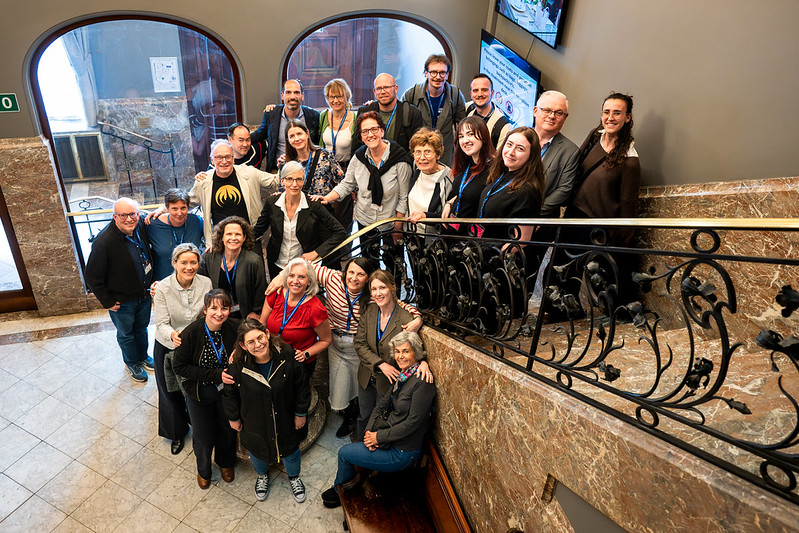
At the heart of the initiative is a strong commitment to research based learning. On 13 March 2026, the CC organised a workshop in Brussels bringing together master’s students from VUB, alongside a group from Ljubljana, to present and refine their thesis proposals.
Rather than a traditional classroom setting, the workshop was designed as an interactive research environment. Students prepared short research abstracts, engaged with materials from other legal disciplines, and worked in small, interdisciplinary groups.
The structure was deliberately hands-on. Students pitched their ideas, received structured feedback from peers and professors, and were encouraged to identify key challenges in their research.
During the workshop, this exchange was further enriched by contributions from academics across the CC, including colleagues from the University of Stellenbosch, Ljubljana, NOVA Tax Research Lab, and the Brussels Centre for Law, Government and Society (BruCeL). The programme also included dedicated sessions on research methodology, research communication, and dissemination, helping students further develop their thesis projects while encouraging them to consider how their work can reach diverse audiences.
Beyond its immediate impact on student learning, the workshop also reveals something more fundamental about how collaboration is evolving within EUTOPIA. For De Becker, the value of the CC lies not only in what it offers students, but also in how it reshapes academic collaboration.
“It pushes us,” De Becker reflects. “Otherwise, you might postpone ideas or think they are too much work. This framework gives you the momentum to actually do it.”
Beyond providing structure and funding, EUTOPIA enables academics to extend their networks and explore new collaborations. What began as a small partnership has already expanded to include additional institutions and research initiatives, including plans for joint publications and a potential doctoral network.
“It allowed us to break out of the university silos,” she adds.
For students and academics alike, the message is clear: initiatives like this are not about merely learning existing knowledge, but about actively shaping how knowledge is produced and shared across borders.
As De Becker advises, “Reach out, both to colleagues and to the EUTOPIA network. That’s how these collaborations begin.”
Article written by Eric Piaget, Science Diplomacy Coordinator for EUTOPIA.