
cristiana.papahagi@ubbcluj.ro
[FR]
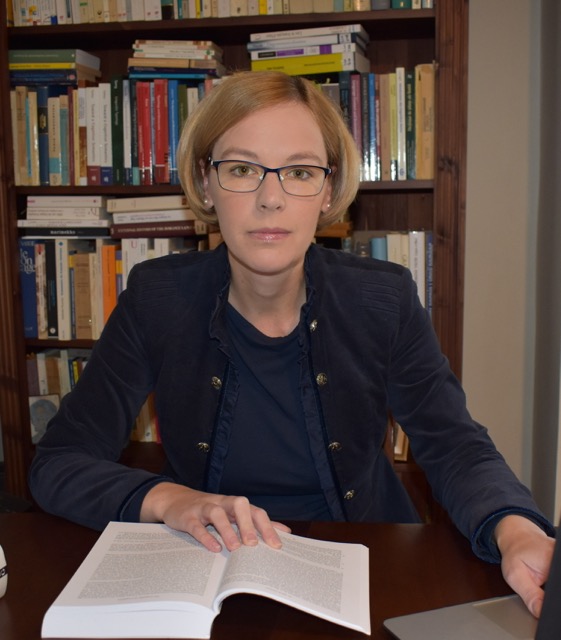
Cristiana Papahagi est maître de conférence HDR en linguistique française et directrice du Département de Langues et Littératures Romanes à la Faculté des Lettres, Université Babeș-Bolyai de Cluj. Elle est docteur en sciences du langage de l’Université Paris 3 – Sorbonne Nouvelle et anciennne élève étrangère de l’École Normale Supérieure rue d’Ulm (1998-2001) ; entre 2002-2004 elle a été ATER à l’Université Charles-de-Gaulle Lille 3, puis chercheur associé au laboratoire DDL (Dynamique du langage, CNRS-Lyon2) avant de rejoindre l’Université Babeș-Bolyai de Cluj. Enseignements actuels : Grammaire et stylistique du français parlé, Histoire de la langue française (licence), Intercompréhension romane, Typologie linguistique (master)
Domaines de recherche : la sémantique du mouvement et de la localisation spatiale, la sémantique des tiroirs verbaux, la diachronie du français, la sociolinguistique historique, les types de changement (grammaticalisation, dégrammaticalisation…), phénomènes sintactico-stylistiques (constructions binomiales, constructions à verbe support, particules verbales, etc.)
Langues : roumain, français, anglais, italien, allemand
[ENG]
Cristiana Papahagi is Habilitated Associate Professor (Reader) in French linguistics and head of the Department of Romance Languages and Literatures at the Faculty of Letters, Babeș-Bolyai University, Cluj. She earned her PhD in Linguistics from Université Paris 3 – Sorbonne Nouvelle in 2005. Between 1998-2001, she was a foreign pupil of the École Normale Supérieure – rue d’Ulm, Paris. She worked as assistant professor at the Charles-de-Gaulle – Lille 3 University in 2002-2004, and as research assistant at the DDL (Dynamique du langage, CNRS-Lyon2), before joining Babeș-Bolyai University. Current teaching: Grammar and stylistics of spoken French, History of the French language (BA level); Romance intercomprehension, Language typology (MA level).
Research areas: the semantics of motion and location, the semantics of tense-aspect-mood, the history of French, historical sociolinguistics, types of grammatical change (grammaticalisation, degrammaticalisation…), syntactic and stylistic phenomena (binomial constructions, light verb constructions, verb-particle constructions etc.).
Languages: Romanian, French, English, Italian, German.