
The community is made up of a group of experts from leading universities across Europe, bringing interdisciplinary learning to explore key issues of Multilingualism and Diversity. We are building a community of students and academics alike, who are passionate about Multilingualism and want to explore the local relevance of global problems. Our goals are to champion diversity and cross-university collaboration, transform the learning experience, and contribute to building a new academic model.
We provide an inspiring and supportive learning environment to help students develop their skills and confidence with innovative pedagogies. Our community aims to bring students from different levels together to give them the chance to collaborate on projects and make global connections. We want to empower students and provide them with the opportunity to be more involved in their own learning experiences. This is why we have launched several pioneering activities, such as the possibility for students to design their module in Multilingualism. We have an exciting programme of activities ranging from courses and workshops to a student-led conference, so join us to be part of a dynamic and global community that is at the forefront of research in Multilingualism and Diversity!
Learning Community Activities
Upcoming Events
Panel: Multilingual Societies, Monolingual mindsets? (13 February, 14:00-17:00 CET, The Bourse in Brussels)
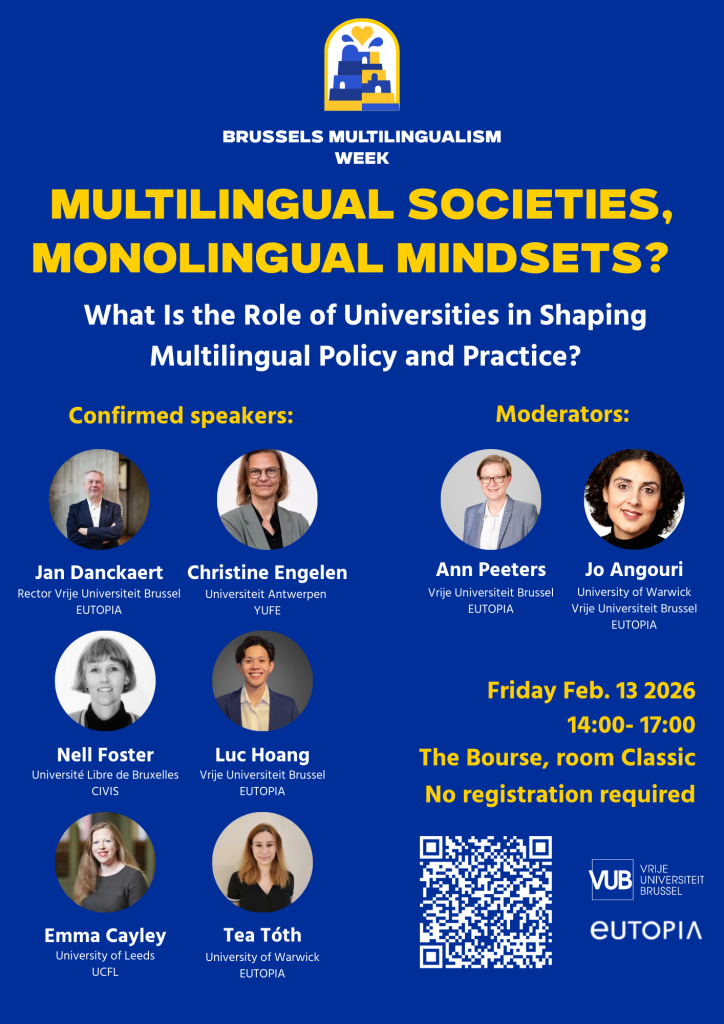
Multilingualism is a core pillar of European life and a prerequisite for its political, economic, and cultural sustainability. Yet, while linguistic diversity is routinely celebrated as an essential identity attribute, it remains absent from the everyday practices of key institutions, including schools, universities, and public services. At the same time, language is also devalued as a subject of study. Across European higher education, language and humanities degrees are being closed or downsized, student recruitment continues to decline, and the languages that remain on offer often do not align with the linguistic landscapes of contemporary European societies. The result is a disconnect: universities operating in multilingual societies while reproducing monolingual norms, hierarchies, and imaginaries.
This panel reflects on these tensions and focuses specifically on the role and responsibility of universities. What does it mean to teach, research, and govern in multilingual societies? How can institutions recognise, support, and develop students’ existing linguistic repertoires rather than treating them as invisible or irrelevant? What kinds of language-related degrees make sense today, and whose languages, knowledges, and futures do they serve? Beyond curriculum reform, what institutional policies are needed to value students’ linguistic capital and to reposition language as a social, cultural, and political resource rather than a mere skill?
Finally, the panel asks whether European University Alliances can play a role meaningfully in this landscape: is it by moving beyond national language hierarchies? pooling linguistic provision across institutions and articulating a more inclusive, socially responsive vision of language education for Europe? The purpose of this panel is to start a public forum which will be hosted by the dedicated expert team on Multilingualism under the EUTOPIA alliance.
- Languages Week 2026 (2-6 March)
Our annual celebration of languages and culture is just around the corner. This year again we will have talks, languages tasters, film screenings, and much more. Programme coming soon – watch this space!
- 2025-2026 Programme of Activities
The Community is pleased to announce its 2025-2026 à-la-carte programme of activities which can lead to a EUTOPIA micro-credential alongside your degree.* This programme is open to Languages and Linguistics students, as well as students from cognate disciplines. You can take online courses from 4 universities under the EUTOPIA Alliance or organise/participate in an international multilingual student conference!
For more detailed information about how the programme works and the activities offered, please see our booklet. For any questions, please contact Dr Mélina Delmas (melina.delmas@warwick.ac.uk).
We look forward to hearing from you!
* A micro-credential is a qualification evidencing learning outcomes acquired through a short, transparently-assessed course or module. Micro-credentials may be completed on-site, online or in a blended format [European Commission].
Past Events
Student Testimonies
Watch Tea’s testimony (University of Warwick) below! She shares her experience of sitting on the organising committee of the 2023 Multilingualism and Diversity Student Conference:
What our students said about the EUTOPIA experience:
“EUTOPIA allowed me to connect with professors and students at universities across the EU, and for this I am grateful. I was able to expand my knowledge by taking courses on communication ethics and international business, both of which are not focuses for my home university’s curriculum. Sharing space with the professors and student through remote learning was a wonderful opportunity that I’m happy to have been afforded through EUTOPIA and the VUB! I can confidently say taking these classes enriched my knowledge and I will take these lessons forward with me in my program and beyond.” (Madeleine Corley, VUB)
“I really enjoy the EUTOPIA experience! I’ve found it a wonderful way to bring in more nuance to my personal curriculum at my home university’s coursework” (Anonymous)
“The EUTOPIA course was a pleasant experience – I was able to learn new concepts which can be potential research topics in the future. […] even though EUTOPIA was not the main reason why I studied in the UK, it has been one of the most memorable experiences I have had there.” (Khoa Do, University of Warwick)
“Lots of fun! I met some great new people and learned skills that have always intimidated me.” (Anonymous)
“It was definitely an unforgettable journey for me to participate in this EUTOPIA programme. I greatly benefited from all the lectures and the whole research process. Besides, it was very fortunate for me to meet these erudite and helpful professors as well as my considerate and diligent teammates. I will cherish this memory for all time.” (Beibei Song, VUB)
How to get involved?
Students: If you wish to get involved, please contact the Learning Community Assistant, Dr Mélina Delmas: Melina.Delmas@warwick.ac.uk
Educators: If you wish to get involved, please contact the Learning Community Lead, Prof Jo Angouri: j.angouri@warwick.ac.uk.