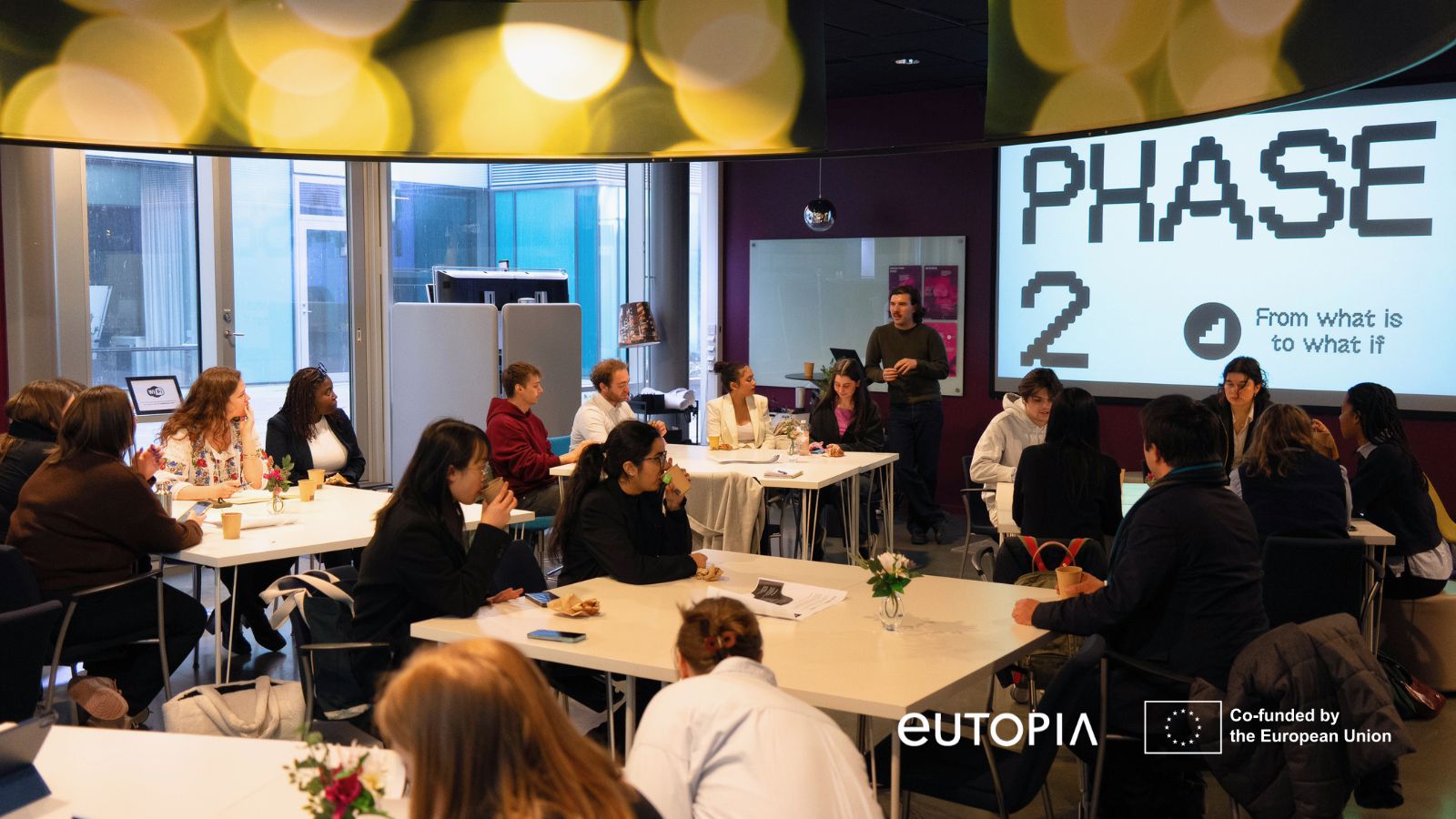
On April 7, 2026, an international group of students from EUTOPIA took part in a workshop on accessibility, inclusive design and universal design at Visual Arena in Gothenburg. The session was organised within the framework of the EUTOPIA Connected Community on Tourism and Experiences, as part of an international day focusing on inclusive tourism and experiences, within EUTOPIA’s research-based learning framework.
The workshop brought together Hospitality and Tourism Management Masters’ students from CY Cergy Paris Université and students in Experience Design, Marketing and Business from the University of Gothenburg. By engaging participants from different academic backgrounds, the initiative aimed to encourage interdisciplinary dialogue and reflection on how inclusion can be integrated into future professional practices.
Designed as an interactive learning experience, the workshop followed a structured progression: notice, discuss, make and share. Students began by conducting an accessibility audit of the Visual Arena building and its surroundings in the Lindholmen Innovation District, using a digital mapping tool to identify potential barriers in physical spaces and services.
Building on these observations, participants worked in groups to analyse specific situations, develop practical improvement proposals, and present their ideas to peers for discussion and feedback. This hands-on approach aimed to make accessibility challenges more tangible, while encouraging students to consider how inclusive design can be applied in real-world contexts.
The workshop also highlighted the importance of integrating diverse perspectives in decision-making processes, particularly the need to involve individuals with lived experience of exclusion when designing services and environments.
By bringing together students from different disciplines and institutions, the activity contributed to strengthening collaboration across the EUTOPIA alliance while supporting the development of skills related to inclusive and responsible innovation.
Further insights into the workshop’s objectives, organisation and outcomes are shared below by the organisers Eva Maria Jernsand and Emma Björner from the School of Business, Economics and Law of the University of Gothenburg:
“This workshop is part of the EUTOPIA alliance, where we collaborate across European universities within our Connected Community on Tourism and Experiences. What we try to do is bring together students, researchers, and external partners to work on real challenges, in this case focusing on inclusion, accessibility, and sustainability.”
“Bringing together students from different levels and disciplines makes the discussions richer and more grounded. Some contributed with perspectives based on their backgrounds in hospitality, management and services, others with knowledge of design methods or user experience. Together they were able to approach challenges in more creative and holistic ways. This approach also reflects EUTOPIA’s ambition to foster challenge‑driven, inclusive learning environments where students from different disciplines and countries collaborate and learn from each other.”
“One important takeaway is the opportunity to step into someone else’s perspective. Several student groups explored accessibility by trying to experience the environment from the point of view of, for example, a visually impaired person, which led to powerful insights.”
“Working in international and interdisciplinary teams also helps them develop skills in collaboration, communication, and problem-solving. But perhaps most importantly, they get to test ideas quickly, going from identifying a problem to proposing and visualising a solution within just a few hours.”
“In their reflections towards the end of the day, students described a shift in how they understand accessibility and inclusion, from something abstract to something tangible and fundamental. As one student put it, “accessibility isn’t a feature, it’s the foundation.”
“It also highlights that inclusion and accessibility are not add-ons, but something that needs to be integrated from the very beginning when designing both digital and physical environments.”