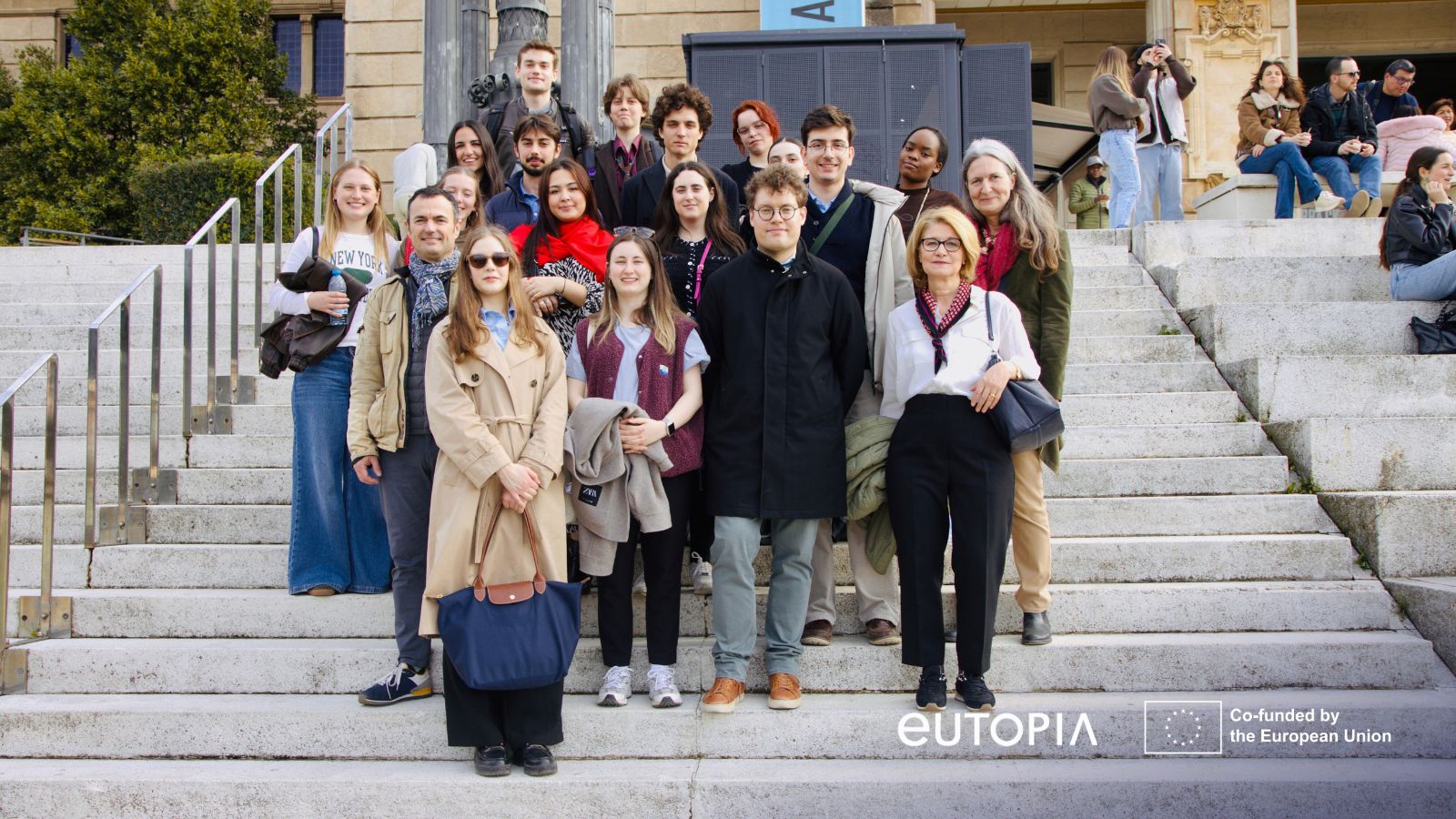
Students and professors from across the EUTOPIA Alliance gathered in Barcelona at the end of February 2026 for the annual peak event of the Connected Learning Community (CLC) on Legal History. Hosted by Pompeu Fabra University – Barcelona (UPF), the meeting brought together participants from Vrije Universiteit Brussel, CY Cergy Paris Université, the University of Ljubljana, and UPF to explore the theme “The End(s) of War.” Over the course of a few days, students presented research examining how conflicts reshape legal systems and how societies use law to address the aftermath of war.
This gathering marked another successful milestone for the Legal History CLC, following past peak events in Paris (2022), Ljubljana (2023), Brussels (2024), and Warwick (2025).
In Barcelona, the programme covered a wide historical range, from early modern conflicts to the aftermath of the war in Yugoslavia. Topics included pacification efforts during the Eighty Years’ War, the repression of Republicans after the Spanish Civil War, and the legal consequences of twentieth-century conflicts. Through these presentations, students examined how law has functioned as a tool for managing the difficult transition from conflict to peace.
For the students involved, however, the experience was about more than presenting research. It was also an opportunity to engage directly with peers from different academic and legal traditions. Galina Hermans, a first-year master’s student in criminal law at VUB, presented research on how the First World War affected Belgian private law, particularly in areas such as family and property law. Although legal history is not her primary specialisation, she found the project offered a valuable perspective on the evolution of legal systems.
One of the highlights for Galina was learning from the work of other students. The presentations from Slovenian participants, in particular, exposed her to historical developments she had not previously encountered. “It was very interesting to see their perspectives on history and on their laws,” she explained, noting that such exchanges help broaden understanding of how different societies approach legal questions.
For many students, the project also represented their first encounter with EUTOPIA. Galina explained that she had not previously been aware of the alliance before participating in the event. The experience therefore provided both an academic opportunity and an introduction to a wider European network of collaboration.
Aichat Okueva, a third-year bachelor’s student in law at VUB, discovered the initiative through a student group chat. Intrigued by the combination of law and history, she decided to take part and developed a presentation on how Belgian neutrality shaped immigration policy, and how the end of that neutrality reshaped these policies over the period from 1839 to 1940.
For Aichat, the international dimension of the event was particularly valuable. Meeting students from other countries offered perspectives that rarely emerge in regular coursework. “You realise how different the histories and legal systems are,” she said, explaining that the project allowed participants to compare approaches and learn from one another in ways that would otherwise be difficult.
Christine Bwanassani, a second-year bachelor’s student in law at VUB, discovered the initiative through a friend who had participated in last year’s edition. Encouraged to apply, she was quickly drawn in by the opportunity to combine academic research with an international experience. In Barcelona, she presented on the legal justifications used during the colonisation of the Congo Free State, examining how jurists at the time sought to classify and legitimise forms of violence. Reflecting on the experience, she noted that the project allowed her to explore a topic in far greater depth than typical coursework, while also experimenting with new ways of approaching legal history.
Like other participants, Christine found the exchange with students from across Europe to be particularly enriching. She highlighted how different presentations, ranging from debates on abortion law in Slovenia to personal accounts of life in Franco’s Spain, offered new perspectives not only on legal systems, but also on how history itself can be studied and communicated. These encounters, she explained, encouraged students to think beyond textbook narratives and to engage more critically with the sources and stories that shape legal understanding.
The event also offered students the chance to experience Barcelona through its historical landscape. Participants explored El Born and Montjuïc, which highlighted Barcelona’s layered past, while museums such as the National Museum of Art and the city’s historical museum provided striking reminders of how art, memory, and political history are intertwined in Catalonia. Before departing, many students also visited the Sagrada Família, the Gaudi masterpiece that defines the city’s skyline.
According to VUB coordinator Professor Frederik Dhondt, the Barcelona meeting constituted yet another success for the CLC. The student presentations were diverse and well prepared, reflecting months of collaboration leading up to the event. On top of that, the gathering further strengthened connections between students and institutions across the EUTOPIA alliance.
For the students themselves, the experience combined academic discovery with international exchange. As Aichat summarised, the project offered the chance to explore a topic of personal interest while meeting people from across Europe and discovering a new city. Her advice to other students is simple: if the opportunity arises, take it.
Christine echoed this sentiment, emphasising that initiatives like EUTOPIA open up opportunities that go beyond the classroom. From building friendships with fellow students to engaging directly with professors in a more informal and collaborative setting, she described the experience as both academically and personally rewarding. For her, it demonstrated the value of thinking beyond national contexts and participating in a wider European academic community.
Galina similarly highlighted the blend of academic and personal experience that defined the event. Beyond developing her research, she emphasised the opportunity to meet new people and engage in meaningful exchanges. “We had really this amazing trip, very interesting conversations, but also a lot of fun,” she reflected. The guided visits offered a way of discovering Barcelona beyond a typical tourist perspective, while the overall experience reinforced a broader sense of optimism. “When you meet all of these wonderful people, you’re a bit reassured in the future of Europe.”
Through initiatives like the Legal History CLC, EUTOPIA aims to create exactly these kinds of experiences: short international collaborations that bring students together to explore complex questions while building lasting connections across universities and cultures.